


How to Choose Upcycled Fashion Fabrics That Last
Quick Summary
Upcycled fashion fabrics reuse surplus material such as mill off-cuts and deadstock, which avoids the water, energy and chemicals of producing new fibre. Their real environmental value depends on sourcing distance, processing intensity and yield, so buyers should check how a brand sources and processes its materials.
- Upcycling keeps existing material largely intact, while traditional recycling breaks fibres down and rebuilds them.
- Textile upcycling can retain an estimated 40-80% of a garment's value, versus 5-15% for traditional recycling.
- Local or regional deadstock keeps the environmental benefit intact, because long-distance shipping erodes it.
- Check fibre content, firm stitching, a smooth lining and care instructions before buying.
- Hand washing and laying pieces flat to dry protect upcycled garments from heat and agitation.
Table of Contents
- Last Updated: November 4, 2026
- Why Upcycled Fashion Fabrics Are Gaining Ground
- Upcycling vs Recycling in Fashion: What Actually Differs
- The Environmental Case: Cutting Textile Waste at the Source
- Is Upcycled Lace Durable? What to Check Before You Buy
- The Economic and Personal Value of Unique Pieces
- Telling Quality Upcycled Goods From Greenwashing
- Choosing Your First Upcycled Piece From Anekdot
- Frequently Asked Questions
Last Updated: November 4, 2026
Upcycled fashion fabrics are moving from niche to mainstream. Fortune Business Insights estimates the global upcycled fashion market at roughly $10 billion in 2026, projected to reach nearly $19.5 billion by 2034 (Fortune Business Insights upcycled fashion market report). At Anekdot, we make intimate apparel from surplus fabric, so we have a direct stake in whether these materials hold up. This guide explains how to judge upcycled fashion fabrics for durability, quality and genuine environmental value before you buy.
Why Upcycled Fashion Fabrics Are Gaining Ground
Demand for recycled clothing has risen sharply, with one industry tracker reporting a 76% year-on-year increase as brands rethink their fabric choices (Just Style report on recycled clothing demand). Much of that momentum comes from brands looking for materials that avoid virgin production altogether.
Upcycling also reflects a shift in what shoppers want. Originality is hard to find in mass-produced garments made from new materials, and upcycled pieces offer a design identity that is difficult to copy.
Upcycling vs Recycling in Fashion: What Actually Differs
Recycling typically breaks fibres down and rebuilds them into new material, which often lowers the quality and value of the input. Upcycling keeps the existing material largely intact and turns it into a higher-value product.
That distinction matters economically. Textile upcycling can retain an estimated 40-80% of a garment's value, compared with 5-15% for traditional recycling (Rud Studio analysis of textile upcycling value retention). The gap explains why upcycling is attractive to designers working with deadstock and off-cuts.
The Environmental Case: Cutting Textile Waste at the Source
The strongest argument for upcycled fashion fabrics is that they intercept waste before it becomes landfill. Surplus fabric from production runs, the off-cuts, end-of-roll remnants and cancelled-order stock that mills and factories already hold, is one of the largest sources of material that would otherwise be discarded. Upcycling turns that material into a finished product without the fibre-growing, spinning and dyeing stages that dominate a garment's footprint.
The mechanism is straightforward: the environmental cost of a fabric is largely paid before it reaches a cutter. Growing cotton, producing polyester from petrochemicals, and dyeing and finishing cloth all consume water, energy and chemicals. When a designer cuts a new garment from existing surplus, those upstream impacts are not repeated. That is why upcycling is often described as avoiding virgin production rather than merely recycling waste.
But the benefit is not automatic, and this is where most articles stop. Researchers have noted that the environmental impact of upcycling is not guaranteed and depends on the specific implementation and design strategy used (NC State University textiles research on upcycling implementation). Three variables decide whether an upcycled piece is genuinely lower-impact:
- Sourcing distance. Surplus shipped across the world carries transport emissions that can erode the savings. Local or regional deadstock keeps the benefit intact.
- Processing intensity. A piece that is heavily re-dyed, chemically treated or bonded with new adhesives adds back some of the impact upcycling was meant to avoid. Mechanical reconstruction, cutting, resewing, patching, is the lowest-impact route.
- Yield. A design that uses most of a remnant generates less new waste than one that cuts a small panel from a large piece and discards the rest. Ask how efficiently the brand uses its input.
Watch out: 'upcycled' on a label does not by itself prove a lower footprint. A garment can be made from surplus fabric and still carry a heavy impact if it is shipped long distances, over-processed or produced in a way that wastes most of the input. Ask how a brand sources and processes its materials, not only whether it uses them.
The practical takeaway for buyers is to treat the environmental claim as a question of degree, not a binary. A locally sourced, mechanically reconstructed piece from a named surplus stream is a stronger environmental choice than a globally shipped, heavily re-finished one, even though both may carry the same word on the tag.
Is Upcycled Lace Durable? What to Check Before You Buy
Durability is the question most buyers should ask first. Lace in particular can look delicate, and a surplus-based piece can vary in quality from batch to batch, so inspect rather than assume.
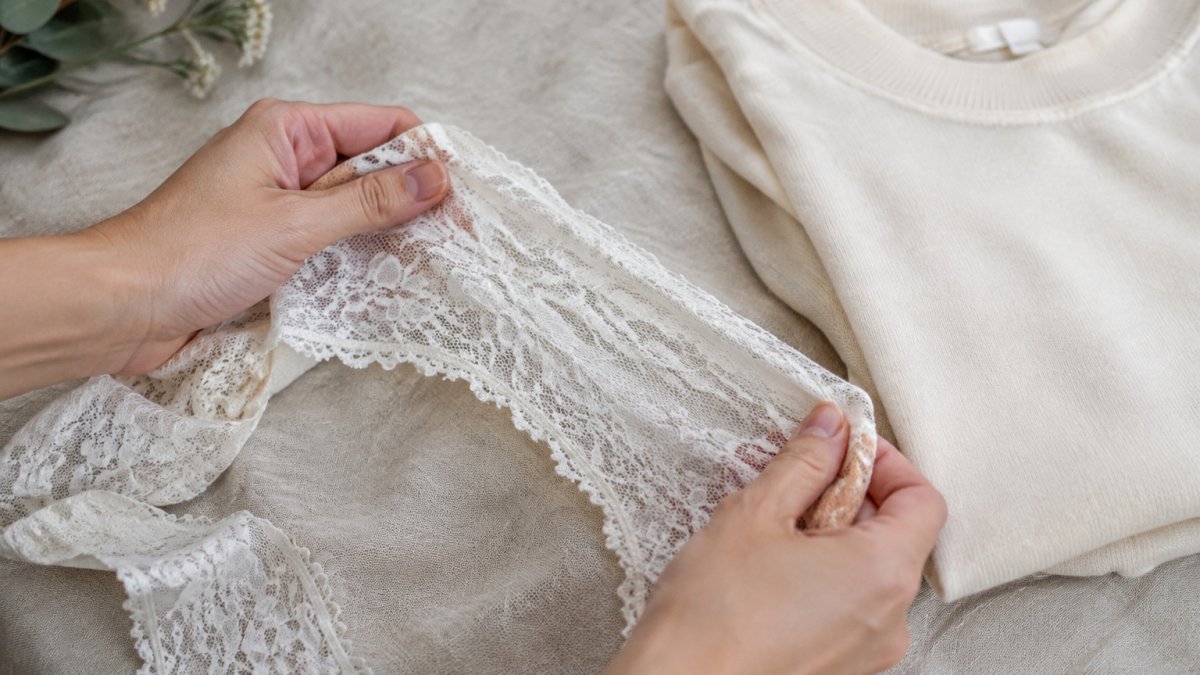
Fibre content and construction
Check the fibre content on the label and look at how the lace is joined to the body fabric. Firm, even stitching at the edges and a lining that sits smoothly are better signs than loose threads or puckering. Our Silk Flutter Knickers, for example, are made from light black silk from Italian leftover stock, with a soft waistband and a gusset lined with organic cotton. Compare the construction of any piece you are considering against details like these.

Caring for upcycled lingerie to extend its life
Most of the wear on lingerie comes from washing and heat. Hand wash or use a gentle cycle, avoid tumble drying, and lay pieces flat to dry. Silk and lace are the most sensitive to rough handling, so a little care goes a long way.
Before you buy, check these points that determine how well an upcycled piece will hold up.
| Check | What to look for | Why it matters |
|---|---|---|
| Fibre content | Stated on the label | Shows what the fabric is made of |
| Stitching | Firm, even edges | Loose threads signal weak construction |
| Lining | Sits smooth | Puckering suggests poor finishing |
| Washing | Hand wash or gentle cycle | Heat and agitation shorten lifespan |
| Drying | Lay flat | Tumble drying causes shrinkage |
The Economic and Personal Value of Unique Pieces
Most coverage of upcycled fashion stops at the planet. The consumer-side economics are where the case is actually won or lost, and they are rarely explained.
Upcycled pieces are often made in limited runs, which means fewer identical items on the market. For buyers, that scarcity can combine with a longer-lasting garment to lower the cost per wear over time. Cost per wear is simply the purchase price divided by the number of times you wear the item. A well-made piece you wear for years can beat a cheaper item that loses its shape after a few washes, even if it costs more up front. The math only works, though, if the garment survives, which is why construction and care matter as much as the initial price.
That is the investment logic: you are paying for material integrity and small-batch construction rather than for volume. The trade-off is real, upcycled pieces are often priced above fast fashion, so the value case depends on how often you will wear the item and how well you maintain it.
Caring for upcycled fabrics so the value holds
Durability is only half the equation; maintenance is the other half. Most of the wear on a garment comes from washing and heat, and upcycled fabrics, especially silk, lace and delicate knits, are sensitive to rough handling. A few habits protect the investment:
- Wash less and cooler. Hand wash or use a gentle cycle with cold water. Heat and agitation break down fibres faster than wear itself.
- Skip the dryer. Lay pieces flat to dry; tumble drying is the single biggest cause of shrinkage and shape loss.
- Store with care. Fold knits rather than hanging them, and keep lace away from snags.
- Repair early. A small stitch at the first sign of a loose seam prevents a larger failure later, and repair is itself a form of upcycling.
Check the care label before you buy, and treat the instructions as part of the product.
There is also a personal dimension that the economics alone do not capture. Wearing something made from a considered material and a small batch tends to make the purchase feel more deliberate, which is why many buyers describe these pieces as more satisfying to wear. The story behind a one-of-a-kind item, where the fabric came from, who made it, why the run was limited, creates an emotional connection that mass-produced garments rarely match. That connection is also practical: people tend to care for and keep the pieces they feel attached to, which reinforces the durability and cost-per-wear case. The economic and the personal arguments, in other words, point the same way.
Telling Quality Upcycled Goods From Greenwashing
Vague claims are common. Look for specifics: where the fabric came from, how much of the product is upcycled, and who made it. Be wary of sustainability language with no supporting detail.
Good signs include named material sources, clear production locations, and transparent descriptions of limited runs. Independent ratings can help too; Anekdot is rated "Great" by Good On You, and you can check the rating directly. Brands that welcome questions about their supply chain are usually more trustworthy than those that deflect them.
Choosing Your First Upcycled Piece From Anekdot
If you are new to upcycled fashion, start small. A low-commitment accessory lets you test the material and fit before investing in more. Our Scrunchie, made from upcycled fabric offcuts, is an easy way to start.

For intimates, our Best Sellers Lingerie is a good place to browse, and Daze Black Briefs are another option to consider. Whatever you choose, check the fibre content, stitching and care instructions first, and buy the piece you expect to wear most often.

Frequently Asked Questions
Is upcycled lace durable enough for everyday wear?
Durability depends on fibre content, construction and how the piece is cared for, not on whether it is upcycled. Look for stitching that is tight and even at the seams and elastic that springs back after stretching. Upcycled lace made from surplus stock can be as durable as new lace when it is well constructed. Hand washing in cool water, drying flat and avoiding the dryer will extend the life of any lace piece considerably.
What is the difference between upcycled and recycled fashion?
Recycling breaks materials down into fibres and rebuilds them into new textiles, which often lowers their quality. Upcycling keeps the original material largely intact and turns surplus fabric, deadstock or off-cuts into a new design. Because the material keeps its structure and quality, upcycled pieces tend to retain more of their original value.
Why is upcycled fashion considered more sustainable than new production?
Upcycling uses fabric that already exists, so it avoids the water, energy and raw material demands of producing new textiles. It also keeps surplus stock out of landfill.
How can I tell if an upcycled brand is genuinely sustainable?
Ask for specifics: where the surplus materials came from, where the garment is made and whether the factory is named. Look at third-party ratings and check whether the claims describe concrete practices instead of vague eco language. Transparent suppliers can usually show you the process behind a piece.
