


Sustainable Luxury Lingerie for Women: 2026 Guide
Table of Contents
- Why Sustainable Luxury Lingerie for Women Is Worth the Investment
- How to Spot Ethical Lingerie Brands (Without Getting Greenwashed)
- Sustainable Cotton Lingerie and the Fabrics That Actually Feel Good
- The Ethical Lingerie Buying Guide: Price, Durability and Cost Per Wear
- Sustainable Lingerie for All Body Types: Fit, Sizing and Comfort
- Inside Anekdot: Upcycled Lace, Berlin Design and a Woman-Owned Polish Factory
- Caring for Sustainable Luxury Lingerie So It Lasts
- Frequently Asked Questions
Last Updated: October 22, 2026
Why Sustainable Luxury Lingerie for Women Is Worth the Investment
Sustainable luxury lingerie for women is intimate apparel made from responsibly sourced or surplus fabrics, produced under fair labor conditions, and built to last beyond a single season. At Anekdot, we design exactly this kind of piece: limited-edition lingerie cut from fashion-industry deadstock and off-cuts, made in a woman-owned factory in Poland. The case for paying more comes down to three things: fabric that feels better against sensitive skin, construction that survives repeated washing, and a supply chain you can actually trace.
Fast-fashion lingerie is cheap for a reason. Thin elastic loses stretch, seams fray, and the piece ends up in landfill within a year. A well-made set behaves differently. It holds its shape, the lace stays soft, and you reach for it again and again.
How to Spot Ethical Lingerie Brands (Without Getting Greenwashed)
The fastest way to spot an ethical lingerie brand is to ask for specifics and watch what happens. Vague claims like "eco-friendly" or "consciously made" mean nothing on their own. Real brands name their certifications, their factories, and their fiber sources. When you ask us where our lace comes from, we can tell you: European lace, surplus materials, a woman-owned Polish factory.
Use this checklist before you buy from any brand, including us:
- Does the brand name its certifications, such as GOTS for organic cotton or OEKO-TEX for tested-safe textiles?
- Can you see where the garment is made, down to the factory or region?
- Does it explain what "recycled" or "upcycled" actually means in practice?
- Are sustainability claims specific enough to verify, or just adjectives?
- Does the brand publish sizing detail and care instructions, or hide them?
That last point matters more than shoppers expect. A brand confident in its product tells you how to wash it and how it fits. One that doesn't is usually hiding something.
Sustainable Cotton Lingerie and the Fabrics That Actually Feel Good
Organic cotton is the safest bet for sensitive skin because it skips the harsh finishing chemicals used on conventional cotton. But "organic" on a hangtag is a claim, not proof. The proof is a certification, and each one verifies something different. Here is how the standards you'll actually see in lingerie compare:
| Standard | What it verifies | Where it applies |
|---|---|---|
| GOTS (Global Organic Textile Standard) | Organic fiber content from harvest through finished garment, plus chemical and wastewater limits in processing | Organic cotton, silk, and other natural fibers |
| OEKO-TEX Standard 100 | The finished textile has been tested for harmful substances at levels considered safe for skin contact | Almost any fabric, including lace and trims |
| GRS (Global Recycled Standard) | Recycled content percentage and chain of custody, plus social and environmental criteria in processing | Recycled polyamide, recycled elastane, recycled cotton |
| FSC (Forest Stewardship Council) | Wood pulp comes from responsibly managed forests | TENCEL lyocell and other wood-pulp fibers |
A brand that names GOTS or OEKO-TEX is telling you which specific claim has been checked. A brand that says "eco-friendly" is telling you nothing you can verify. When you compare two pieces, compare the certifications first, then the fiber percentage on the care label, a "cotton" bralette that is 60% polyester is mostly not cotton.
Beyond cotton, several fabrics earn their place in a sustainable wardrobe, each with a real trade-off:
- TENCEL lyocell, a wood-pulp fiber made in a closed-loop process that recaptures solvents. It drapes softly and breathes well, but it has less stretch than synthetics, so it suits linings, tap pants, and sleepwear more than high-support bras.
- Recycled polyamide and recycled elastane, give stretch and recovery without virgin plastic. They are the practical choice for lace with hold, but they are still synthetics: they shed microfibers in the wash and do not biodegrade, which is why a wash bag and cooler water matter.
- Deadstock and upcycled lace, surplus fabric rescued before it becomes waste. The trade-off is limited runs and uneven size availability; when the roll is gone, the piece is gone.
- Silk remnants, like the Italian surplus silk in our Daze Black Set. Silk feels cool and gentle on reactive skin, but it needs hand-washing and fades in direct sun.
Our Lotus White Set pairs decorative stretch lace with soft recycled nylon, a combination that feels gentle and moves with you. For anyone who reacts to synthetic trims, start with cotton-rich pieces and patch-test anything lacy on your inner arm first.


The Ethical Lingerie Buying Guide: Price, Durability and Cost Per Wear
Cost per wear is the only price comparison that matters in luxury lingerie. Divide the price by the number of times you'll realistically wear the piece. A €45 pair of cheeky panties worn twice a week for two years costs under €1 per wear. A €10 pair that falls apart in three months costs more.
Here is how our own collection breaks down, so you can plan a wardrobe rather than a splurge:
| Piece | Price | Best For | Cost-Per-Wear Logic |
|---|---|---|---|
| Earth Black Cheeky Panties | €45 | Everyday rotation | Lowest entry point, highest wear frequency |
| Earth Black High Panties | €55 | Smoothing under dresses | High-leg cut flatters and stays put |
| Earth Black Soft Bra v2 | €89 | Daily support, fuller coverage | Braless-feel comfort with real hold |
| Earth Black Triangle Bra | €89 | Statement layering | Bares more, wears beautifully under open shirts |
| Lotus White Set | €130 | Bridal, gifting, everyday luxury | Two-piece value, timeless white |
| Earth Black Cheeky Set V2 | €130 | First full set | Coordinated look at a set price |
| Dea Silk Set | €150 | Occasions, sensitive skin | Silk chiffon, no wires or padding |
| Daze Black Set | €150 | Pure silk luxury | Italian surplus silk, featherlight |
Buy the €45 panties first if you're testing a brand. Buy a set once you trust the fit. That's how we'd advise a friend to start.
Sustainable Lingerie for All Body Types: Fit, Sizing and Comfort
Body-inclusive sizing starts with construction, not a size chart. Our Earth Black Soft Bra v2, for example, delivers the most coverage and hold in our collection despite having no wire or padding, and its straps convert from classic to cross-back to halter.

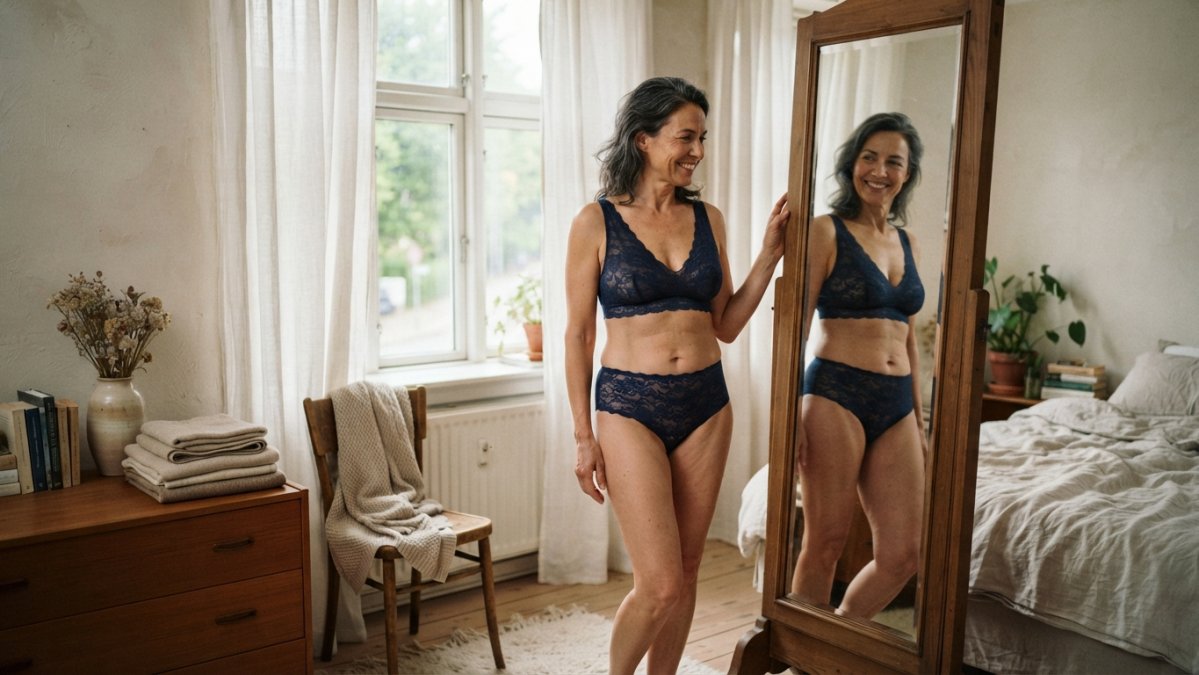
Most fit problems in lingerie come from three things: measuring once and guessing forever, assuming a size means the same thing across brands, and buying a cut that fights your shape. Here is how to work through each.
Measure, then check the brand's own chart. Measure your underbust snugly and your bust loosely, then compare those numbers to the specific brand's chart rather than a generic converter.
Match the cut to the job. Wire-free, unpadded styles suit a wider range of shapes because the fabric follows you rather than forcing a shape.
Judge support by construction, not by wire. Support in a wire-free bra comes from the band, the strap placement, and the fabric's recovery.
Know what inclusive sizing actually requires. A brand can print a wide size range and still cut every piece from one sample size.
Inside Anekdot: Upcycled Lace, Berlin Design and a Woman-Owned Polish Factory
Transparency is easy to claim and hard to prove, so here is ours in plain terms. Every Anekdot piece is designed in Berlin and manufactured in a woman-owned factory in Poland. We work with European lace and organic cotton, and we cut from surplus materials sourced from fashion-industry deadstock and off-cuts. That means limited-edition runs: when a fabric is gone, it's gone.
We're rated "Great" by Good On You, an independent rating platform that assesses brands on people, planet, and animals. We mention it not as a badge but as a checkpoint you can verify yourself.
Caring for Sustainable Luxury Lingerie So It Lasts
Hand-washing in cool water is the single best thing you can do for lace, silk, and recycled nylon. Hot water and tumble dryers break down elastic and dull lace faster than anything else. Wash after two or three wears, not every wear, and use a gentle detergent without bleach.
A simple care routine:
- Rinse in cool water with a drop of mild detergent.
- Gently squeeze, never wring, and roll in a towel to absorb water.
- Dry flat away from direct sun and radiators.
- Store folded, not hung, so straps keep their shape.
- Rotate your pieces so no single set takes all the wear.
When a piece finally reaches the end of its life, check whether the fabric can be recycled through a textile take-back scheme rather than sent to landfill. Silk and cotton biodegrade; blended elastics don't, which is why buying fewer, better pieces matters.
The challenge with sustainable lingerie isn't finding pretty pieces. It's finding pieces you can trust, from a brand that shows its work. Anekdot builds limited-edition intimates from upcycled lace, surplus silk, and organic cotton, designed in Berlin and made in a woman-owned Polish factory, with wire-free comfort that suits real bodies.
Frequently Asked Questions
What makes lingerie sustainable?
Sustainable lingerie combines lower-impact materials with production you can trace. Look for upcycled or deadstock fabric, recycled polyamide and recycled elastane, organic cotton, TENCEL lyocell and European lace, plus certifications such as GOTS and OEKO-TEX. Production matters too: small-batch runs, fair-trade manufacturing and a supply chain the brand can name. A set made from surplus materials in a woman-owned factory, like Anekdot's pieces designed in Berlin, keeps waste and transport down while giving you a garment built to last.
How can I tell if a lingerie brand is ethical or just greenwashing?
Ask for specifics and see whether the answers hold up. A credible ethical lingerie brand names its fabric sources, its factory and its certifications, and publishes that information where you can find it without emailing support. Vague phrases like 'eco-friendly' or 'conscious collection' mean little on their own. Check independent ratings such as Good On You, look for GOTS or OEKO-TEX certification on materials, and see whether the brand explains how off-cuts and deadstock are used. If a claim cannot be traced to a place or a certificate, treat it as marketing.
Is sustainable luxury lingerie comfortable enough for everyday wear?
Yes, and the construction matters more than the label. Wireless soft bras with seamless edges, adjustable straps and hook-and-eye front closures sit smoothly under clothes and avoid the digging that wired styles can cause. Look for breathable natural fibers next to sensitive skin, such as organic cotton or silk, and stretch from recycled elastane for movement. A well-fitted bralette in upcycled lace can be worn all day, and many people find it more comfortable than a padded, underwired bra for long stretches.
How do I care for lingerie so it lasts longer?
Wash less often than you think, and wash by hand in cool water with a gentle detergent. If you use a machine, put pieces in a mesh bag on a delicate cycle and skip the dryer, because heat breaks down elastane and lace. Fasten hooks before washing to stop snagging, and lay flat to dry away from direct sun. Rotating a small number of well-made sets and storing them flat keeps shape and stretch intact, which is how a higher upfront price turns into a low cost per wear over several years.
Are there sustainable lingerie options for different body types?
Look for brands that offer a genuine size range and styles with adjustable fit rather than a single mould. Soft bras with versatile straps, high-waisted panties with a high leg opening and cheeky cuts with seamless edges flatter different shapes and can be adjusted at the back and shoulders. Body-inclusive sizing plus detailed fit guidance, such as how a style runs and what it covers, matters more than a size label. Anekdot's Classic Collection is designed to work across body types with adjustable straps and hook closures.