


5 Sustainable Bras for Sensitive Skin That Feel Good
Last Updated: October 25, 2026
Quick Summary
The best sustainable bras for sensitive skin are wire-free, unpadded, and made with a soft base fabric against the body. Anekdot's five picks include the New Moon Soft Bra for its light wavy-edged lace and the Dea Silk Bralette in 100% Italian silk surplus, all priced from €89 to €95.
- Check full fiber composition including trim, elastic, and closures, not just the headline fabric.
- A 2024 Journal of Cancer Survivorship study found bras affect survivors' sense of normalcy and control.
- Wash before first wear in fragrance-free, dye-free detergent and skip fabric softener entirely.
- If reactions come from elastic and closures, start with the front-hook Ether or Lotus styles.
- Measure your underbust snugly against the size chart, since a band one size off will drag or press.
Table of Contents
- Quick Comparison: 5 Sustainable Bras for Sensitive Skin
- How to Choose a Bra for Sensitive Skin
- Organic Cotton Bras and Natural Fibers for Irritation-Prone Skin
- Hypoallergenic Bras: What the Label Should Tell You
- Plastic-Free Bras and the Trim Details That Matter
- The Five Bras in Detail: Fit, Fabric, and Price
- Care and Washing to Reduce Skin Irritation
- Shop Your Fit at Anekdot
- Frequently Asked Questions
Quick Comparison: 5 Sustainable Bras for Sensitive Skin
Finding 5 sustainable bras for sensitive skin starts with one uncomfortable truth: a soft fabric claim on the tag tells you almost nothing about how a bra will behave against reactive skin. At Anekdot, we design wire-free soft bras from surplus and deadstock materials, so we read fabric labels for a living. The five bras below share three traits: no underwire, no padding, and a soft base fabric against the body.
| Bra | Price | Fabric | Support Level | Best For |
|---|---|---|---|---|
| Ether Soft Bra | €89 | Decorative lace, wire-free cups | Light to medium | Everyday wear, nursing |
| Earth Black Soft Bra v2 | €89 | Stretch lace on soft nylon base | Most coverage in the collection | Fuller busts wanting coverage |
| New Moon Soft Bra | €89 | Soft, elastic lace with wavy edges | Light | Sensitive skin, all-day comfort |
| Lotus White Soft Bra | €89 | Elastic lace on soft nylon base | Light to medium | Convertible strap wear |
| Dea Silk Bralette | €95 | 100% Italian silk surplus | Light | Luxurious bare-skin feel |
A 2024 study in the Journal of Cancer Survivorship found that survivors' experiences with bras directly affect their sense of normalcy and control amid bodily changes from treatment (study on breast cancer survivors' undergarment needs). That finding applies well beyond one group: what a bra feels like against the skin shapes how you carry yourself all day.
How to Choose a Bra for Sensitive Skin
Choosing a bra for sensitive skin comes down to four checks: fabric composition, wire-free construction, seam and trim placement, and a fit that doesn't press or rub. Start with the fiber list, not the headline claim. A bra marketed as organic cotton can still contain elastane, nylon trim, or a hidden synthetic lining.
Then work through the practical checks:
- Wire-free first. Underwire concentrates pressure along the ribcage, which is where irritation-prone skin complains first.
- Read every fiber, not the first one. Trim, elastic, and hook-and-eye closures touch skin too.
- Check the seams. Flat or bonded edges reduce friction points under the bust and at the strap join.
What most guides miss: breathability matters as much as softness. Breathable cotton traps less heat than many synthetics, and heat plus moisture is what sets off irritation-prone skin.
Organic Cotton Bras and Natural Fibers for Irritation-Prone Skin
Organic cotton bras suit sensitive skin because the fiber is breathable, absorbs moisture, and carries no pesticide residue from growing.
Our own approach leans on silk rather than cotton for the softest contact layer.
Watch out: "plant-based" and "natural" describe the fiber's origin, not the finished garment. A natural-fiber bra can still carry chemical dyes or stiffened trims, so the composition list remains the only reliable guide.
Hypoallergenic Bras: What the Label Should Tell You
A hypoallergenic bra label should disclose the full fiber composition, the dye type, and where the garment was made.
It helps to know what "hypoallergenic" actually means on a garment.
Here is what to look for, in order of usefulness:
- Full composition percentages, including lining and trim. A shell-only disclosure hides the elastic and closure materials that sit against friction zones.
- Dye disclosure, ideally plant-based or low-impact dyes. Disperse dyes are a known trigger for some reactive skins, and dark saturated colors generally carry more dye than pale ones.
- Certification names, such as a recognized organic or textile-safety standard. A certification is evidence of a tested process, not a guarantee for your skin, but it narrows the variables.
- Manufacturing location, since finishing processes vary by factory.
- Care instructions, because residue from harsh detergents and fabric softeners worsens allergen exposure over time.
If a label lists only the shell fabric and stays silent on trim, treat the hypoallergenic claim as unproven.
How to isolate an irritant without wasting money. Change one variable at a time.
What this means for the five bras above. The Dea Silk Bralette has the simplest contact story: one main fiber, silk, with metal hardware at the straps and back. The New Moon Soft Bra has the lightest edge finish, reducing seam friction. The front-hook styles concentrate metal at the center front, so if you react to hardware, watch that contact point. None is a medical device or tested on individual skin; they reduce common triggers, not eliminate every possible one.
Plastic-Free Bras and the Trim Details That Matter
Plastic-free bras are rare, and any brand claiming otherwise deserves scrutiny: elastic, thread, strap adjusters, and hook-and-eye closures are usually synthetic. A bra can be plastic-free in its main fabric and still contain plastic at every point where it grips the body.
That matters for sensitive skin because trim sits closest to friction zones. The details worth checking:
- Underbust elastic: soft, wide bands distribute pressure better than narrow ones.
- Strap hardware: metal rings and sliders avoid the sharp molded edges some plastic adjusters have.
- Closures: a front or back hook-and-eye in coated metal is easier on skin than a tight elastic loop.
- Edge finish: wavy or scalloped lace edges sit lighter than bound seams.
Our Ether Soft Bra uses silver-toned metal rings at the straps and a vintage-inspired front hook closure. The Breeze Mesh Bralette uses ultra-soft bi-stretch mesh with softly waved edges. Neither is fully plastic-free.
The Five Bras in Detail: Fit, Fabric, and Price
Each of our five bras solves a different sensitive-skin problem, and the differences come down to fabric weight, coverage, and closure placement rather than dramatic design changes. Every pick is assessed against the same six criteria: fiber and trim composition, wire and padding status, support level, sizing range, closure and hardware, and care and return details. Where a detail is not published on the product page, we say so rather than guess.
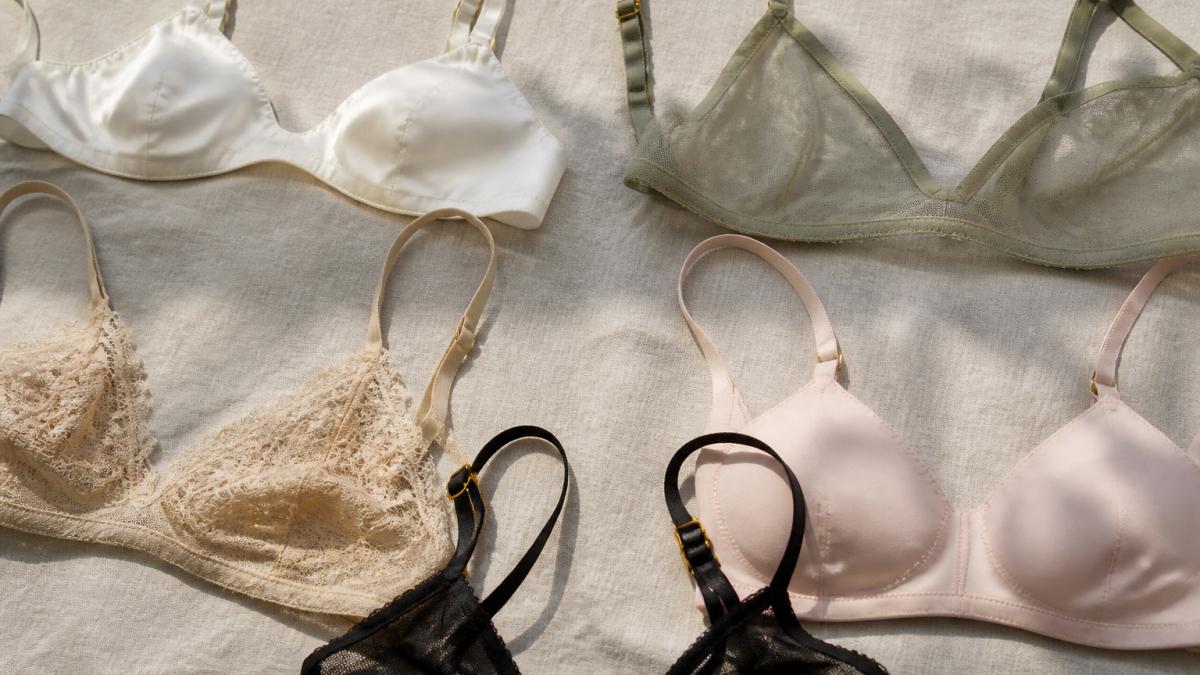
Ether Soft Bra, €89. A wire-free, unpadded soft bra with decorative lace, silver-toned metal rings at the straps, and a vintage-inspired front hook. Confirm your band measurement against the size chart, since the front hook offers less incremental adjustment than a back hook-and-eye. See the Ether Soft Bra.

Earth Black Soft Bra v2, €89. The same wire-free shape with the most coverage and support in our collection. The back hook-and-eye gives more band adjustment than the front-hook styles. View the Earth Black Soft Bra v2.
New Moon Soft Bra, €89. Made from especially soft, elastic lace with gentle wavy edges that move with the body. Explore the New Moon Soft Bra to check its fabric and fit details. Check the product page for exact fiber percentages and trim details if you are avoiding specific synthetics. Explore the New Moon Soft Bra.
Lotus White Soft Bra, €89. Elastic lace over a soft nylon base, with a front hook and straps you can wear crossed, halter-style, or classic, useful if you want one bra to cover several necklines. Check the Lotus White Soft Bra for specs and purchase options. The convertible strap hardware adds metal contact points at the shoulder. Check the Lotus White Soft Bra.

Dea Silk Bralette, €95. 100% Italian silk surplus with adjustable straps and a back closure. At €95 it is the highest price of the five, reflecting the surplus silk sourcing rather than added construction. Shop the Dea Silk Bralette.

How to read this comparison. None of the five uses underwire or molded padding, so the meaningful differences are fabric weight, edge finish, closure type, and hardware. If reactions come from elastic and closures rather than the main fabric, start with the front-hook styles (Ether, Lotus) and check the hook coating. If they come from texture and seam friction, start with the Dea Silk Bralette or the wavy-edged New Moon. If you need the most coverage and support, the Earth Black Soft Bra v2 is the only one built for that priority.
Care and Washing to Reduce Skin Irritation
Washing correctly removes the residue behind most contact reactions and protects the fabric that makes these bras comfortable. Three habits do most of the work.
- Wash before first wear. This clears residual dye and finishing agents.
- Use a fragrance-free, dye-free detergent. Enzymes and perfumes are frequent triggers.
- Hand wash or use a mesh bag on a delicate cycle, then air dry away from direct heat.
Skip fabric softener entirely: it coats fibers and reduces breathability, working against everything a sensitive-skin bra is meant to do. If a bra still irritates after two washes, the fit is usually the culprit, so recheck band tension before blaming the material.
Shop Your Fit at Anekdot
Sensitive skin doesn't need a medical-grade wardrobe. It needs garments that disclose what they're made of, sit lightly, and last through repeated washing.
Start with the Ether Soft Bra for everyday lace comfort, or the Dea Silk Bralette if smooth silk suits you better. Browse the full Anekdot shop to find your fit. Browse the full Anekdot shop to find your fit and see what's currently in stock.
Frequently Asked Questions
Are organic cotton bras better for sensitive skin?
Organic cotton is often a good starting point because it is breathable and traps less heat than many synthetics, which helps reduce sweating and friction. Check the full fiber composition rather than the headline claim: bras marketed as 100% organic cotton can still contain hidden non-cotton fibers.
Why do I get a rash every time I wear a bra?
Common triggers are underwires pressing into the skin, tight elastic, scratchy seams, and synthetic fabrics that hold heat and moisture. Wire-free, unpadded designs with soft stretch lace or silk reduce pressure points. Wash new bras before wearing them to remove manufacturing residues, and switch to a gentle, fragrance-free detergent.
What is the healthiest fabric for a bra if my skin is reactive?
Breathable natural and plant-based fibers such as organic cotton, silk, and bamboo are frequently recommended for reactive skin, and merino wool works for some people. Breathable cotton traps less heat than many synthetics. Silk is another option: the Dea Silk Bralette from Anekdot is made from 100% silk surplus sourced in Italy, with adjustable straps and a back closure. Whatever you pick, check the trim and elastic too, not just the cup fabric.
How can I tell whether a bra is sustainably made?
Look for specific, checkable claims: named materials, the country of manufacture, and whether the fabric is surplus or deadstock. Anekdot designs in Berlin and manufactures in a woman-owned factory in Poland, using European lace and upcycled materials, and Good On You rates the brand 'Great'. Vague words like 'eco-friendly' without a fiber breakdown or production location are a warning sign. Certification and manufacturing transparency are the details that separate evidence from marketing.
How should I wash bras to help prevent skin irritation?
Hand wash in cool water with a gentle, fragrance-free detergent, rinse thoroughly, and air dry flat away from direct heat. Residue from harsh detergents and fabric softeners is a common source of allergen exposure against the skin, so skip softener entirely. Wash new bras before the first wear. Rotating between several bras lets elastic recover between wears, which extends durability and keeps the fit consistent, especially with delicate lace and silk styles.
