


Is Slow Fashion Lingerie Worth It for Mature Women?
Quick Summary
Slow fashion lingerie is intimate apparel made in small batches from lower-impact materials, with clear sourcing and a focus on durability and fit. For women over 45, it offers practical value alongside ethical sourcing, with pieces designed for comfortable support and coverage.
- Slow fashion lingerie is made in small batches with a clear account of where and how it was produced.
- Our Earth Black Soft Bra v2 is unpadded and wireless, with the most coverage and support in our collection.
- A well-fitting bra should feel secure on the loosest hook and sit flat without gaping.
- Re-check your bra fit every year or two, since bodies change through life.
- Wash lingerie by hand or on a delicate cycle, skip fabric softener, and rotate two or three bras.
Table of Contents
- What Slow Fashion Lingerie Means for Mature Women
- Comfortable Bras for Mature Women: Support, Coverage and Straps
- How to Find the Right Bra Fit as Your Body Changes
- Lingerie for Sensitive Skin: Fabrics That Feel Good Against the Skin
- How to Tell Whether Sustainability Claims Hold Up
- How to Care for Delicate Lingerie So It Lasts
- Choosing Your First Slow Fashion Lingerie Pieces
- Frequently Asked Questions
What Slow Fashion Lingerie Means for Mature Women
Last Updated: October 28, 2026
Slow fashion lingerie is intimate apparel made in small batches, from lower-impact materials, with a clear account of where and how each piece was produced. For women over 45, the appeal is practical as well as ethical. At Anekdot, we design our intimates in Berlin and manufacture them with a woman-owned factory in Poland, using European lace and organic cotton.
Slow fashion lingerie is clothing produced at a deliberately modest pace, where the emphasis falls on durability, fit and transparent sourcing rather than rapid turnover. Research on sustainable fashion consumption, including a 2025 study of women's sustainable-fashion consumption, shows that women's buying decisions are shaped by values as much as by price and style. A 2022 literature review of slow-fashion consumer behaviour points to the same pattern: buyers who value longevity tend to buy less and keep what they buy.
Mature women have a particular stake in this.
Our Earth Black Soft Bra v2 is unpadded and wireless, with the most coverage and support in our collection, and it has flexible straps.
Comfortable Bras for Mature Women: Support, Coverage and Straps
Our Earth Black Soft Bra v2 offers the most coverage and support in our collection.
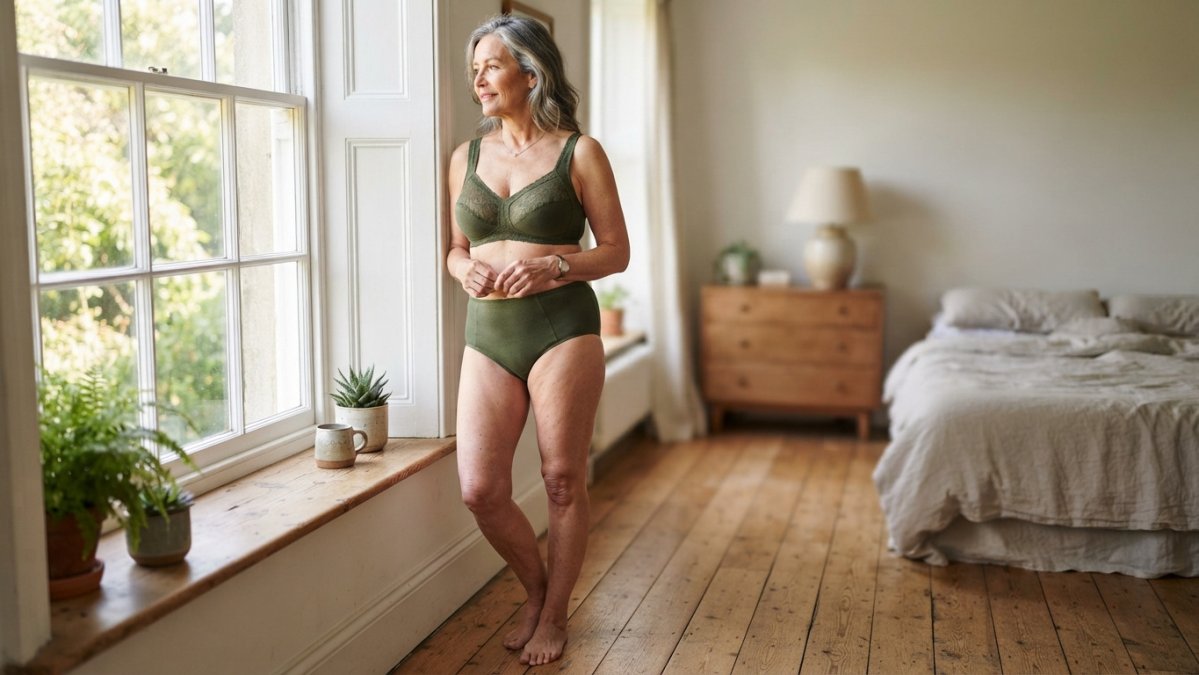
Straps are a detail worth checking.
- Ether Soft Bra: Vintage-inspired hook fastening and silver rings on the straps, with a decorative lace finish.
- Lotus White Soft Bra: Soft elastic lace on a nylon base, with straps you can wear crossed, as a halter or classically.
- Earth Black Soft Bra v2: Maximum coverage and support in our range, with flexible straps.
The three bras in this section differ mainly in their coverage, straps and finish.
| Bra | Key feature | Strap detail |
|---|---|---|
| Ether Soft Bra | Vintage-inspired hook fastening | Silver rings, decorative lace finish |
| Lotus White Soft Bra | Soft elastic lace on nylon base | Wearable crossed, halter or classic |
| Earth Black Soft Bra v2 | Maximum coverage and support in range | Flexible straps |
How to Find the Right Bra Fit as Your Body Changes
A well-fitting bra should feel secure on the loosest hook, sit flat against the body without gaping, and have straps that do not dig in. Because bodies change through life, it is worth re-checking your fit every year or two rather than assuming your old size still works.
Measure band and cup at home
A common pattern among fitters is to start with two measurements. For the band, wrap a soft tape snugly around your ribcage directly under the bust, keeping it level, and round to the nearest whole number. For the cup, measure around the fullest part of the bust, again keeping the tape level and not pulling tight. The difference between the two measurements indicates cup size: roughly one inch per cup letter in many sizing systems, though this varies by brand and country. Treat the result as a starting point, not a final answer, because band and cup sizing is not standardized across labels.
Diagnose common fit problems
- Band rides up at the back: the band is too loose. Try a smaller band size and adjust the cup accordingly.
- Cup gapes at the top or centre: the cup may be too large, or the shape may not match your breast tissue distribution. A different cup construction can help more than a size change.
- Spillage at the top or sides: the cup is likely too small, or the band is too loose to hold the cup in place.
- Straps dig in or slide off: straps should carry only a small share of the weight. If they dig in, the band is probably not doing enough work; if they slide off, the strap placement or width may not suit your shoulder shape.
- Underwire presses or pokes: the wire may be sitting on breast tissue rather than around it. A wireless or softer-band design can be a better match for sensitive or changing tissue.
How age-related changes affect fit
Changes in weight, hormones, posture and muscle tone all affect fit. Many women find they need a different band size after a shift in weight, or a different cup as breast tissue changes. Skin becomes more sensitive with age for many women, so seams, wire casing and elastic finishes matter as much as size. Posture changes can alter how a band sits across the back, and shoulder shape can affect whether straps stay in place. Adjustable straps and a softer band can absorb some of that change, but they cannot fix a bra that is badly sized.
When to see a professional fitter
Our Motherhood Nursing Bras are worth considering if your fit has changed significantly, since they are designed for adaptable support during life stages that alter the shape of the bust.
Lingerie for Sensitive Skin: Fabrics That Feel Good Against the Skin
Our pieces use European lace and organic cotton, and our Lotus White Soft Bra is built on a soft nylon base.
Our listings describe materials, not skin-health outcomes, so we cannot promise that any piece will suit a specific condition.
How to Tell Whether Sustainability Claims Hold Up
Sustainability claims in fashion can be hard to verify, and lingerie is no exception. A consumer guide to sustainable lingerie warns explicitly about greenwashing and advises shoppers to scrutinise materials and claims rather than accept broad statements at face value. The practical skill is knowing which questions produce checkable answers and which produce only reassurance.
Start with fiber content
Look at the fiber composition on the care label, not the marketing copy. Natural and lower-impact fibers such as organic cotton, linen, hemp and Tencel (lyocell) are generally easier to trace than blended synthetics, though blends can improve durability. Note whether the label states a certification for the fiber itself, such as GOTS for organic cotton or OEKO-TEX Standard 100 for tested harmful substances. A certification is not proof of an ethical supply chain, but it is a checkable claim rather than a vague one.
Ask where and how it was made
A transparent brand can usually tell you the country of manufacture and, often, the factory. Vague language such as "ethically made" or "conscious" is not, on its own, evidence. Look for named production partners, stated batch sizes or limited-edition runs, and any information about working conditions or audits. If a brand cannot say where a garment was made, that is a signal to ask more questions before buying.
Check independent ratings and certifications
Third-party ratings and certifications are useful starting points, not substitutes for your own check. Good On You's brand rating assesses brands on planet, people and animals, and a rating such as "Great" indicates the brand has met certain published criteria. Other schemes, including B Corp certification and Fair Trade certification, cover different aspects of production. Read what each scheme actually evaluates rather than treating any logo as a blanket guarantee.
Match claims to the product in front of you
At Anekdot, we use upcycled materials sourced from fashion-industry deadstock and off-cuts, and we make our pieces in limited editions.
Where a claim matters to you, contact the brand directly and ask for specifics.
How to Care for Delicate Lingerie So It Lasts
Lingerie lasts longest when it is washed gently, dried flat and rotated rather than worn on consecutive days. Elastic and lace are the parts most likely to fail, and both suffer from heat and friction.
Wash by hand or on a delicate cycle in a mesh bag, using a mild detergent and cool water. Avoid fabric softener, which can coat elastic and reduce its stretch. Reshape the cups and lay pieces flat to dry, away from direct heat or sunlight.
Rotating two or three bras and a few pairs of underwear extends the life of each piece, because the elastic has time to recover between wears. A bra worn every day will lose its shape faster than one worn two or three times a week.
Choosing Your First Slow Fashion Lingerie Pieces
Our Earth Black High Panties are high-waisted with a high leg and seamless edges.
Browse our full range of [lingerie bras | page:1] and [lingerie panties | page:5].
Frequently Asked Questions
What should mature women look for when choosing lingerie?
Start with fit and support rather than trend. Look for adjustable straps, a band that stays level across the back, and cups that sit flat without gaping. Soft, unpadded styles with flexible elastic often feel more comfortable as the body changes. Check that the fabric breathes and that the cut gives enough coverage for daily wear. Slow fashion lingerie often focuses on fewer, better-made pieces, which suits a considered wardrobe built around comfort and longevity.
Which lingerie fabrics are comfortable for sensitive skin?
Natural fibres such as organic cotton are often a good starting point for sensitive skin because they are breathable and soft. Pair them with smooth, well-finished seams and minimal elastic at the edges. European lace can feel delicate but may scratch some skin types, so test a small area first. Choose fabrics that you can check against the product listing, and avoid assuming that a label alone guarantees gentleness. If you react to a fabric, note it and look for alternatives.
How do you know whether lingerie is sustainably made?
Look for specific, checkable details rather than broad claims like eco-friendly. Brands that publish their fabric sources, production location, and whether pieces are made in small batches or to order give you more to assess. Upcycled or deadstock materials should be described clearly, with an explanation of where they came from. Be cautious of vague language with no supporting detail, since that is a common sign of greenwashing. Good sustainability information should answer where, how and in what quantity a piece was made.
How should you care for lingerie to make it last longer?
Hand wash or use a gentle cycle in a laundry bag, with cool water and a mild detergent. Avoid fabric softener, which can reduce elasticity over time. Dry flat or hang bras rather than tumble drying, since heat weakens elastic and lace. Rotate pieces so that no single bra takes all the wear, and reshape cups while damp. Careful washing and drying usually extends the life of a well-made piece far longer than the cost of replacing it.
Ready to build a more considered wardrobe? Shop Anekdot's limited-edition intimates, made in Berlin from upcycled materials, and find pieces that feel beautiful against the skin for years to come.
