


Is Upcycled Lace Actually Durable?
Last Updated: October 26, 2026
Quick Summary
Is upcycled lace actually durable? Its durability depends on the specific piece rather than on it being upcycled. Fibre type, thread structure, prior condition and construction determine how long it lasts, and the research has not directly tested upcycled lace performance.
- Fibre type is the strongest predictor of how lace will age, with nylon and polyester resisting abrasion better than cotton or silk.
- Dense, multi-thread junctions distribute load, while single-thread bridges between motifs tend to fail first.
- Deadstock is usually the most consistent source, since a single roll shares one fibre lot and one dye lot.
- Check stretch recovery by gently stretching a section and letting go; lace that stays distorted will likely sag with wear.
- Use a mesh laundry bag, wash cool on a gentle cycle, and press water out in a towel instead of wringing.
Table of Contents
- What the Research Says About Upcycled Lace and Durability
- Where Upcycled Lace Comes From and Why Its Origin Matters
- Signs of Quality Lace: How to Judge a Piece Before You Buy
- Durability by Use: Lingerie, Accessories, Tablecloths and Decor
- How to Wash Lace Lingerie So It Lasts
- How to Care for Lace Lingerie and Repair Lace Fabric When It Frays
- Choosing Your Next Lace Piece: What to Look for at Anekdot
- Frequently Asked Questions
Is upcycled lace actually durable? It's a fair question, and the honest answer is that the research has not yet tested it directly. Anekdot builds lingerie and accessories from surplus lace and fabric, so we are close to this question every day, and we would rather tell you what the evidence does and does not show than sell you a story. Here's what we know, what we don't, and how you can judge a piece for yourself.
Repairing and repurposing clothing can extend how long it stays in use, according to a 2022 study on extending clothing lifetimes through repair and repurposing. That finding is broad. It does not measure how well upcycled lace holds up to washing or wear.
What the Research Says About Upcycled Lace and Durability
The research discussed here does not measure how well upcycled lace holds up to washing or wear.
The 2022 study on extending clothing lifetimes through repair and repurposing draws a distinction worth borrowing. It separates a garment's technical lifetime, how long it functions as designed, from the act of repurposing, which can extend use. Those are different questions. A piece can be reused for years and still be fragile, or it can be sturdy and never upcycled at all. Durability is a property of the material and construction; upcycling is a property of the supply chain.
Market forecasts, such as Fortune Business Insights' projection for upcycled fashion through 2034, tell you demand is growing. They tell you nothing about how a single piece of lace will perform against your body, your wash cycle, or a table edge.
So here is the framework we use instead of a durability claim. Four factors determine whether upcycled lace holds up:
- Fibre type. Nylon and polyester filaments resist abrasion and retain strength when wet; cotton and silk lose tensile strength in water and are more prone to rot and UV degradation. A lace's fibre content is the single strongest predictor of how it will age.
- Thread and motif structure. Lace is a network of threads, and its weak points are the junctions where motifs meet. Dense, multi-thread junctions distribute load; single-thread bridges between motifs concentrate it and fail first.
- Prior life. Surplus and deadstock lace may have been stored folded, exposed to light, or handled repeatedly. Creases along fold lines and faded patches signal fibre fatigue before any hole appears.
- Construction. How the lace is joined to lining, elastic, or trim matters as much as the lace itself. A strong lace with a weak seam is a weak garment.
What this means practically: upcycled lace can be durable, but not because it is upcycled. It is durable when the fibre, structure, prior condition, and construction align with the demands of the intended use. The next sections show how to check each of those.
Where Upcycled Lace Comes From and Why Its Origin Matters
Upcycled lace typically comes from three streams: deadstock (unsold rolls from past production), off-cuts (remnants from cutting tables), and reclaimed garments. Each stream leaves a different fingerprint on durability, and knowing which one you are looking at tells you what to inspect.
Deadstock is the most common source for small brands. Rolls may have sat in warehouses for seasons, sometimes years. The failure mode is not usually visible holes but fibre fatigue: elastic filaments in stretch lace lose recovery, and folded edges develop permanent creases that become the first place to fray. Deadstock is often the most consistent option because a single roll shares one fibre lot and one dye lot, so weight and stretch are uniform across pieces cut from it.
Off-cuts are the least predictable. They come from many production runs, so a single garment may combine lace panels with different stretch, weight, and fibre content. That is not automatically a durability problem, but it means the weakest panel sets the garment's life. Inspect each panel separately rather than judging the piece by its most attractive section.
Reclaimed garments carry the most history and the most risk. Prior washing, sunlight, and mechanical stress may have already consumed part of the fibre's useful life. The tell-tale signs are softness without structure, faded color in exposed areas, and thin spots along stress lines such as underarm seams or strap attachment points.
NC State University's explainer on how fashion brands are embracing upcycling describes the practice and its sustainability rationale, though it does not measure fabric performance. The supply-chain story is real, but it is not a durability specification.
Origin matters because it tells you which inspection to prioritize. Single-roll deadstock: check for storage creases and elastic recovery. Mixed off-cuts: check panel-to-panel consistency. Reclaimed garments: check for prior wear at stress points. The next section walks through the checks themselves.
Signs of Quality Lace: How to Judge a Piece Before You Buy
You can check a lot before you pay. Here is what we look for, and what you can check yourself:
- Edge finish: Look for clean, closed edges. Loose threads at the border often mean the piece will fray quickly.
- Density of the motif: A tight, even pattern usually holds shape better than a sparse one with large open areas.
- Stretch recovery: Gently stretch a section and let go. Good lace springs back. If it stays distorted, expect it to sag with wear.
- Seam construction: Check how the lace joins other fabric. Flat, well-secured seams last longer than thin, bulky ones that pull.
- Fibre content: Read the label. Blends with some synthetic content typically resist abrasion better than very fine natural fibres alone.
None of these checks guarantees longevity. Together they tell you whether a piece is built with care.
Before you buy, you can check several things yourself. These are the checks the article recommends:
| Check | What to look for | Why it matters |
|---|---|---|
| Edge finish | Clean, closed edges | Loose threads often mean fraying |
| Motif density | Tight, even pattern | Holds shape better than sparse lace |
| Stretch recovery | Springs back after stretching | Distorted lace tends to sag |
| Seam construction | Flat, well-secured seams | Thin, bulky seams tend to pull |
| Fibre content | Blends with some synthetic content | Often resists abrasion better than fine natural fibres |
Durability by Use: Lingerie, Accessories, Tablecloths and Decor
How long upcycled lace lasts depends on what you ask it to do. Lingerie faces constant stretching, friction and frequent washing, so it needs the most attention to fit and care. Accessories such as hair ties see less stress, though elastic and fabric edges still wear over time. Tablecloths and decor face fewer stretch forces but more exposure to light and occasional spills.
For a hair accessory, the scrunchie made from our trimmed fabric offers a simple example of a low-stress use. You can read more about it at Anekdot's transparent scrunchie made from upcycled fabric offcuts. Choose the product for its job, and the durability question becomes much easier to answer. You can also see the hair ties made from surplus materials for another low-stress option. If you prefer upcycled materials, you can explore the handmade accessories made from upcycled silk and swimwear scraps.
How to Wash Lace Lingerie So It Lasts
Washing causes more damage to lace than almost anything else. A few habits make a real difference:
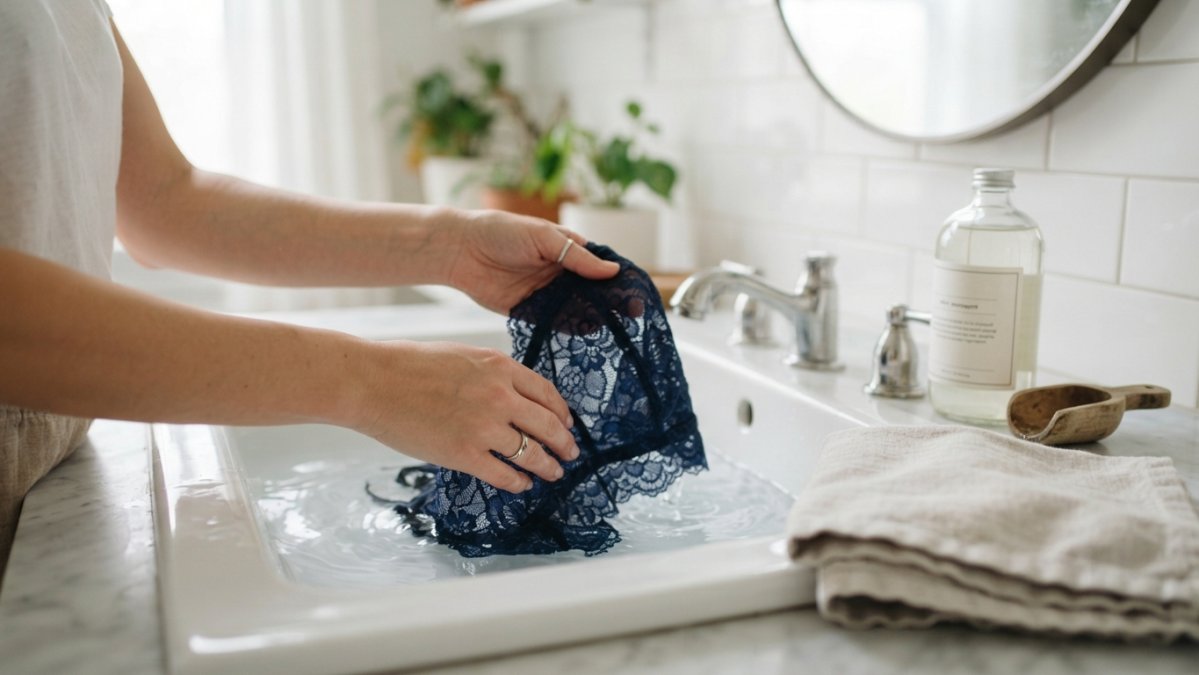
- Use a mesh laundry bag for every lace piece.
- Wash on a gentle or hand-wash cycle with cool water.
- Use a mild detergent without bleach or optical brighteners.
- Never wring or twist. Press water out in a towel instead.
- Lay the piece flat or hang it to dry, away from direct heat.
Following these steps won't make weak lace strong, but it stops avoidable damage.
How to Care for Lace Lingerie and Repair Lace Fabric When It Frays
Store lace flat or loosely folded so it does not stretch out of shape. Keep it away from rough surfaces that snag, and rotate pieces so none is worn constantly.
When a thread starts to pull, act early. Stop the run with a dab of clear fabric glue on the back, then trim any loose ends close to the surface. A small fray caught quickly is far easier to fix than a large tear. For significant damage, a skilled repair is worth the cost on a piece you love.
Choosing Your Next Lace Piece: What to Look for at Anekdot
If you are choosing a lace piece from our range, start with the use you have in mind. You can browse the lingerie range to compare styles and materials. Our Saga Navy Underwire Bra, for example, is built around a floral lace with adjustable straps, so fit and stretch recovery matter most. Check the product listing for the materials used, then apply the inspection steps above.
You can explore the full Anekdot lingerie range with navy and black lace styles. For a lower-stress option, the Saga Navy String and Saga Cut-Out Briefs share the same lace family in a different cut.
Upcycled lace can be durable, but durability depends on the piece, the use and the care it gets. We would rather you check the seams and read the label than trust a slogan. If you have questions about a specific piece, ask us before you buy.
Frequently Asked Questions
Is upcycled lace durable enough for everyday wear?
Anekdot transforms surplus materials into limited-edition lingerie and swimwear. The verified information does not establish how durable upcycled lace is for everyday wear.
How can you tell if lace is strong or fragile?
Stretch a small section gently in both directions. Strong lace springs back to its shape, while fragile lace shows thinning, holes or fibers that pull apart. Look closely at the mesh: even, tight knots and consistent threads suggest good construction, whereas loose or uneven patterns often fray first. Check where the lace meets seams and straps, since these areas take the most stress. Finally, look at the fiber content on the label or product information. Synthetic blends often hold their shape better through repeated washing than delicate natural fibers, though this depends on the specific construction.
Can damaged lace be repaired?
Small tears and loose edges can often be repaired. For a small hole, trim any loose threads, then stitch the edges together with a fine needle and matching thread, working in small, even stitches. For larger areas or lace trim that has come away from its base, a small amount of fabric glue designed for textiles can hold the edge in place, but test it on a scrap first to check for stiffness or discoloration. Repairs are most successful when they are done early, before the damage spreads. Delicate lingerie may be better left to a professional seamstress for structural repairs near seams or straps.
How should you wash and care for upcycled lace lingerie?
Hand wash your upcycled lace lingerie in cool water with a mild, pH-neutral detergent, and avoid soaking it for long periods. Place each piece in a mesh laundry bag if you machine wash, and select a gentle cycle with a low spin. Never wring the fabric; press out water gently in a towel instead. Lay pieces flat to dry, away from direct heat and sunlight, which can weaken fibers and fade color. Rotating between two or three pieces gives each one time to recover its shape between wears.
