


How to Verify Sustainable Lingerie Claims
Quick Summary
To verify sustainable lingerie claims, check for named certifications such as GOTS, GRS or OEKO-TEX with a certificate number you can look up, then ask for exact recycled percentages and the factory or mill names behind each component. Vague words like "eco" or "conscious" with no evidence are a warning sign.
- Look up certificate numbers in the certifying body's public database, not just the logo on the page.
- Ask for exact recycled percentages and which garment components they cover.
- Trace supply chain tiers: fibre, mill, trim and cut-and-sew factory, checking each name in Open Supply Hub.
- Read the technical data sheet and check the LCA scope, functional unit and baseline before accepting figures.
- Note that elastane in the band and straps may not be recycled even when the cup fabric is.
Table of Contents
- Why Sustainable Lingerie Claims Need Checking
- Understanding Sustainable Fabric Certifications
- How to Spot Greenwashing in Fashion
- Step-by-Step: Checking a Brand's Supply Chain Transparency
- Reading Technical Data Sheets and Lifecycle Claims
- Testing Elasticity, Fit and Durability Before and After Buying
- Your Next Step: Auditing the Lingerie You Already Own
- Frequently Asked Questions
Why Sustainable Lingerie Claims Need Checking
Last Updated: October 30, 2026
Sustainable lingerie is a growing category, and so are the claims attached to it. Words like "eco," "conscious," "recycled" and "organic" appear on almost every intimate apparel page.
Sustainable lingerie claims are statements about materials, production and supply chain practices that a brand makes to show its products are more responsible. Those claims are only as useful as the evidence behind them. European Commission proposal on substantiating green claims would require environmental claims to be verified by an independent, accredited third party, which shows how seriously regulators now treat vague wording.
Here is the core problem. A label can say "eco-friendly" without naming a single material, certificate or percentage. Knowing which questions to ask turns a vague marketing promise into something you can actually test.
Understanding Sustainable Fabric Certifications
Fabric certifications are the most useful starting point for checking claims. A certificate names a standard, and that standard names specific tests and limits.
Certifications are not all equal. Some cover the fibre itself, some cover processing chemicals, and some cover the whole supply chain. Knowing the difference tells you what a label actually promises.
Reading GOTS, GRS and OEKO-TEX Labels
Three labels appear most often on intimate apparel. Each checks something different:
- GOTS (Global Organic Textile Standard): Covers organic fibre content and the processing steps that follow, including chemical limits and social criteria.
- GRS (Global Recycled Standard): Verifies recycled content and tracks it through the supply chain.
- OEKO-TEX: Tests finished textiles for harmful substances. It says nothing about how the fibre was grown or recycled (OEKO-TEX® STANDARD 100).
Check whether a certificate number is listed and whether it matches the product. A logo on a website is not enough. Ask any brand for the certificate number and look it up in the certifying body's public database.
Decoding Recycled Content Percentages
A label that says "made from recycled materials" tells you very little. Ask for the exact percentage, the material it came from, and whether the figure is verified. A product labelled "70% recycled nylon, GRS certified" gives you something to check. A product labelled "eco-nylon" does not.
Remember that a percentage describes the fabric blend, not necessarily the whole garment.
How to Spot Greenwashing in Fashion
Greenwashing happens when a brand makes environmental claims that are vague, unproven or misleading. It is rarely a single lie. It is usually a pattern of soft language that avoids specifics.
Watch for these warning signs:
- Broad words like "conscious," "green" or "natural" with no measurable detail
- A single eco feature used to suggest the whole product is sustainable
- Certification logos with no certificate number or link
Ask one direct question: "What exactly is the evidence?" A brand that has evidence can point you to it. A brand that does not will usually change the subject.
Step-by-Step: Checking a Brand's Supply Chain Transparency
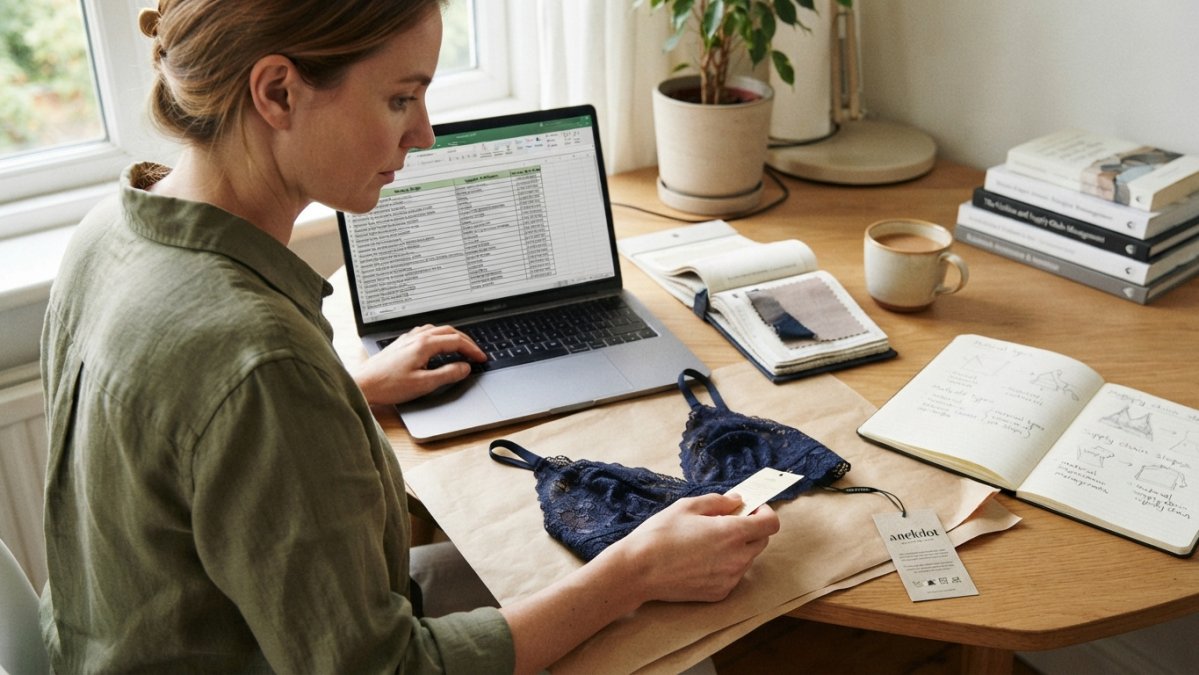
Supply chain transparency means a brand can name where each part of a garment is made, and, ideally, prove it. For lingerie that means at least four tiers: the fabric mill, the lace or trim supplier, the component maker (elastic, hooks, underwires) and the cut-and-sew factory. Most brands disclose only the last one. Here is a practical sequence for checking what is actually disclosed.
Step 1: Map the tiers the brand names
Start on the product page and any impact or transparency page the brand publishes. Write down every tier named: fibre source, mill, trim supplier, factory, finishing. A brand that names only "made in Portugal" has disclosed one tier. A brand that names the mill and the sewing factory has disclosed two. Note the gaps, they are the questions to ask.
Step 2: Cross-check factory names against public databases
The most useful free tool is the Open Supply Hub (formerly the Open Apparel Registry), which maps factory names and addresses submitted by brands and civil society. Search the factory name a brand gives you.
For labour evidence, look for audits against recognised standards rather than a brand's own code of conduct. SA8000, Fair Trade certification and amfori BSCI audit summaries are the common ones in apparel.
Step 3: Trace the materials, not just the garment
Trim is often the hardest part of a garment to trace. Ask specifically:
- Lace: which mill, and is it certified (for example, OEKO-TEX Standard 100 for harmful substances)?
- Elastic: which supplier, and is any of it recycled or bio-based?
- Hooks and underwires: metal or plastic, and where sourced?
A brand that can name its lace mill and elastic supplier is offering more transparency than one that can only name the sewing factory.
Step 4: Test consistency across channels
Compare what the website says with the care label, the packaging and what customer service tells you. A common pattern is a detailed sustainability page that does not match the fibre content on the physical label. Inconsistency between channels is a stronger warning sign than a missing detail, because it suggests the claim was written for marketing rather than sourced from the supply chain.
Step 5: Ask for the evidence chain
Send one email with three specific requests: the certificate numbers for any fibre certifications, the factory name and address for cut-and-sew, and the name of the lace mill. A brand with a real evidence chain can answer within days. A brand without one will usually reply with a general statement about "commitment to sustainability", which is the answer to a different question.
Watch out: A factory name alone does not prove fair labour practices, and an audit summary is not a guarantee. Ask for the audit standard, date and rating, and treat a missing factory address as an unanswered question rather than a red flag on its own.
Reading Technical Data Sheets and Lifecycle Claims
Most sustainability content stops at the label. The real due-diligence skill is reading the documents behind the label: the technical data sheet (TDS) and the lifecycle assessment (LCA) summary. Brands rarely put these on the product page, but a credible one will send them on request. Here is how to read them without a materials science degree.
What a technical data sheet actually contains
A TDS is a spec sheet written for manufacturers, not shoppers. It usually lists:
- Fibre composition by percentage, for example, "78% recycled polyamide, 22% elastane." This is the number the marketing page often rounds or hides.
- Fabric weight (usually in g/m² or GSM). Heavier knits tend to be more durable; very light lace is more fragile regardless of fibre.
- Dye and finish processes, reactive dye, piece dye, or solution dye. Solution-dyed fibres use less water because colour is added before the fibre is spun.
Read the composition first. If the TDS says "recycled" but the percentage is single-digit, the claim is doing more work than the material is.
How to read an LCA summary
A lifecycle assessment measures impact from raw material through production, transport, use and end of life (LCA & EF methods - Green Forum). Intimate apparel is a hard case: pieces are small, use many materials, and are washed frequently. When you open an LCA summary, check four things:
- Scope. Which stages are included? A "cradle-to-gate" figure stops at the factory gate and excludes washing and disposal. A "cradle-to-grave" figure includes them. Comparing the two is comparing apples to oranges.
- Functional unit. Impact is expressed per something, per kilogram of fabric, per garment, or per year of wear. Per-year figures reward durability; per-garment figures can hide a short lifespan.
- Method and baseline. Is the number measured or modelled? What is it compared against, a conventional nylon, a previous version of the product, or an industry average? A reduction claim with no named baseline is not yet testable.
- Uncertainty. Good LCAs state a range, not a single precise number. A claim of "50% lower impact" with no range or methodology footnote deserves a follow-up question.
The elasticity paradox in lingerie
Here is the gap most guides ignore. Lingerie needs stretch to fit and recover, and stretch almost always means elastane (spandex), a synthetic fibre that is difficult to recycle and rarely made from recycled content.
When you read a TDS or LCA for an elastic-heavy garment, ask:
- What percentage of the total garment weight is elastane, and is any of it recycled?
- Is the elastane segregated or blended into the yarn? Blended stretch fibres are much harder to recycle at end of life.
- Does the brand's end-of-life guidance match the material reality, for example, advising repair or take-back rather than kerbside recycling that will not accept elastane blends?
A brand that answers these questions specifically is doing more than most. A brand that answers only with the cup fabric percentage is telling you where its claim stops.
Before accepting any sustainability figure, check these key elements in a technical data sheet or lifecycle summary.
| Document element | What to check | Why it matters |
|---|---|---|
| Fibre composition | Percentage by fibre | Shows which parts are actually recycled |
| Fabric weight | g/m² (GSM) | Heavier knits tend to last longer |
| Dye process | Reactive, piece or solution dye | Solution dye uses less water |
| Certificate reference | GOTS, GRS or OEKO-TEX number | Lets you verify the claim publicly |
| LCA scope | Cradle-to-gate or cradle-to-grave | Decides whether figures are comparable |
| Functional unit | Per garment, kg or year of wear | Per-year figures reward durability |
| Baseline | Named comparison product | Without it, a reduction claim is untestable |
| Uncertainty | Range or methodology note | Single precise figures can overstate accuracy |
Testing Elasticity, Fit and Durability Before and After Buying
Claims about longevity are only useful if the garment holds up. You can check this yourself with a few simple tests.
- Before buying: Read the fibre content. Higher elastane content usually means better stretch recovery, but also less breathability. Check whether the product page gives size charts with real measurements.
- Right after arriving: Stretch the band and cup gently. It should snap back. Check the seams and the lace edges for loose threads.
- After washing: Wash according to the care label, dry flat if advised, and compare the shape and elasticity to the day it arrived. Repeat after several washes.
Keep notes. A simple record of how the elastic feels after each wash makes it easy to judge whether a durability claim holds.
Sustainability and durability are often linked. A piece that lasts longer usually has a smaller footprint per year of wear, but only if it actually lasts.
Your Next Step: Auditing the Lingerie You Already Own
Start with what is in your drawer. Pick three pieces and check the label for fibre content, certificate numbers and factory information. Note what you can verify and what you cannot.
Then browse the brand's New Arrivals Lingerie to compare current labels and specs against what you have learned. The Best Sellers Lingerie collection lets you check the same details on popular pieces. When you are ready to test fit and durability, look at Lingerie Panties, Lingerie Bras and Lingerie Sets.
A good brand will welcome these questions. Anekdot's pieces are designed in Berlin and manufactured in a woman-owned factory in Poland, and we are glad to share what we can about each step.
Frequently Asked Questions
What are the most reliable sustainability certifications for lingerie?
The most useful certifications are GOTS for organic fibres, GRS for recycled content, and OEKO-TEX Standard 100 for harmful substance testing. Each covers a different claim, so a garment can be certified on one point and silent on others. Check the certificate number on the certifier's public database rather than trusting a logo alone. Certifications should be treated as one part of a broader verification process, not a guarantee on their own.
How can I tell if a lingerie brand is greenwashing?
Look for specifics. Vague phrases like 'eco-friendly' or 'conscious' without percentages, named materials or verifiable certificates are a warning sign. Check whether the brand names its factories and countries, and whether claims are tied to particular product codes or SKUs. Brands that share supplier data and material composition per product are easier to verify than those offering only broad statements.
Why is surplus fabric considered sustainable in lingerie?
Surplus fabric, often called deadstock, is material already produced but unused by other manufacturers. Using it avoids new raw-material extraction and reduces textile waste. Anekdot's upcycled lace and fabric come from fashion-industry deadstock and off-cuts, so the claim can be checked by asking for the source and the quantity of surplus material used in a given collection.
How do I research a lingerie brand's supply chain transparency?
Start with the brand's own disclosures: factory names, locations and whether the factory is independently audited. Then look for supplier lists, material origin and labour standard information. Anekdot names its Berlin design base and its woman-owned factory in Poland, which gives you concrete locations to check. If a brand cannot tell you where a garment was made, treat its ethical claims with caution.
